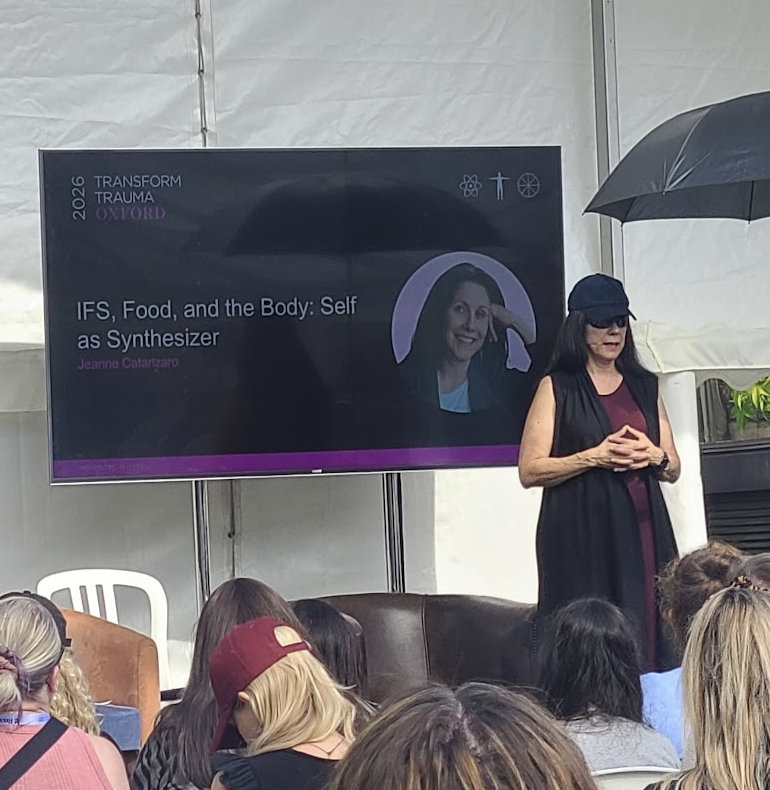
This is part of my Oxford Trauma Conference Reflections, a series on the ideas I’m bringing back into my psychotherapy work in Toronto and how they are shaping the way I think about trauma, relationships, the body and healing.
Jeanne Catanzaro’s session on IFS, food and the body gave me a much deeper understanding of how parts work can be used when thinking about our relationship with food.
I already love Internal Family Systems.
My primary therapeutic orientation is relational and psychodynamic, but I frequently use parts language in my work because it gives us such an intuitive way of approaching internal conflict without immediately pathologising it.
One part wants something.
Another part absolutely does not.
One part wants closeness.
Another is terrified of being dependent.
One part knows we need rest.
Another says resting means we are lazy.
Food gives those conflicts another place to play out.
What Jeanne’s session helped me think about more deeply was not simply what somebody is eating, but which part wants to eat and what that part believes eating will do for them.
Maybe there is a part that reaches for food when we feel alone.
Maybe food allows that part to soothe a younger part that feels frightened or abandoned.
Maybe another part becomes highly controlling around food because it believes control will protect us from judgement.
Then another part rebels against that control.
And another criticises us afterwards.
Suddenly what looked like one “problem behaviour” becomes an entire internal relationship.
That changes how we respond to it.
If I only focus on stopping the behaviour, I may end up fighting the protector without ever understanding who or what it is protecting.
IFS invites a different sequence.
First, notice the part.
Get curious about it.
Ask what it is trying to accomplish.
Then ask what it fears would happen if it stopped.
Often that takes us somewhere deeper.
There may be a younger part underneath carrying shame, fear, deprivation, loneliness or the experience of having very little control.
The eating part may not be the wounded part at all.
It may be the one desperately trying to take care of it.
This is what I love about IFS.
It does not begin by asking us to get rid of the parts of ourselves we find inconvenient.
It assumes they developed for a reason.
In IFS, protective parts are understood as attempting to manage or prevent pain, even when the strategies they use eventually create problems of their own.
For me, the therapeutic question becomes:
What are you protecting, and can we get to know the part that needed that protection in the first place?
Jeanne’s session made the relationship between food and parts feel much more vivid to me.
A craving can have a history.
Restriction can have a history.
Comfort eating can have a history.
Control can have a history.
And rather than immediately trying to remove those strategies, therapy can help us understand the relationship between the protector and the pain underneath it.
Sometimes the behaviour begins to make far more sense once we meet the whole internal system.
Leave a Reply